
On-page SEO is one of the most important parts of improving a website’s visibility on Google. It focuses on optimizing the content and elements on your website so that search engines can better understand your pages and users can find useful information easily.
Whether you run a small business website, blog, e-commerce store, or service-based website, proper on-page SEO can help improve your search visibility and attract more relevant visitors.
In this guide, we will discuss 10 important on-page SEO factors that can help improve your Google rankings.
What Is On-Page SEO?
On-page SEO refers to optimizing the elements available directly on your website. This includes your page content, title tag, headings, URLs, images, internal links, and other elements that help search engines understand the purpose of a page.
The goal is not simply to add keywords everywhere. Instead, you should create useful, relevant, and well-structured content that satisfies the user’s search intent.
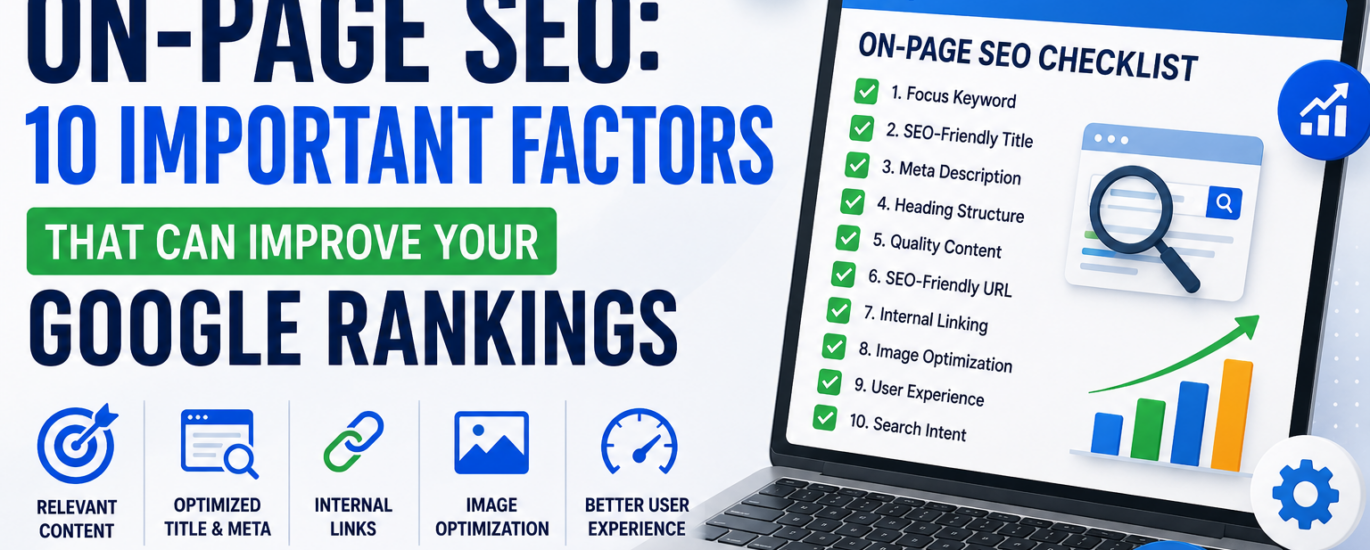
10 Important On-Page SEO Factors
1. Use a Relevant Focus Keyword
Every important page should have a clear primary keyword or topic.
For example, if your page is about SEO services in Delhi, your focus keyword could be SEO services in Delhi.
Use the keyword naturally in important areas such as:
- Page title
- Main heading
- Introduction
- Subheadings where relevant
- URL
- Meta description
- Image alt text where appropriate
Avoid keyword stuffing because excessive keyword usage can make the content difficult to read.
2. Write an SEO-Friendly Title Tag
The title tag helps Google and users understand what your page is about.
A good title should be clear, relevant, and attractive enough to encourage users to click.
For example:
On-Page SEO: 10 Important Factors to Improve Google Rankings
Keep the main topic close to the beginning of the title whenever possible.
3. Create a Useful Meta Description
A meta description provides a short summary of your webpage in search results.
It should explain what users will find on the page and encourage them to click.
For example:
Learn 10 important on-page SEO factors that can help improve your website’s visibility, user experience, and Google rankings.
Google may sometimes rewrite the meta description, but writing a relevant one is still a good SEO practice.
4. Use Proper Heading Structure
Headings make your content easier to understand for both users and search engines.
Use one clear H1 heading for the main topic and organize the rest of the content with H2 and H3 headings.
For example:
H1: On-Page SEO: 10 Important Factors
H2: What Is On-Page SEO?
H2: 10 Important On-Page SEO Factors
H3: Use a Relevant Focus Keyword
H3: Write an SEO-Friendly Title Tag
A logical heading structure also makes longer articles easier to scan.
5. Create High-Quality and Helpful Content
Content is one of the most important parts of on-page SEO.
Your content should answer the user’s questions, provide useful information, and match their search intent.
Instead of writing content only to include keywords, focus on providing practical information that your target audience can actually use.
Good content should be:
- Relevant to the topic
- Easy to understand
- Well structured
- Original and useful
- Written for people first
6. Optimize Your URL
A clean and descriptive URL helps users and search engines understand the page topic.
For example:
example.com/on-page-seo-factors/
is better than:
example.com/page?id=12345
Keep URLs short, descriptive, and relevant to the main topic.
7. Add Internal Links
Internal links connect one page of your website to another.
For example, an article about on-page SEO could link to your SEO services, SEO audit, technical SEO, or other relevant blog posts.
Internal linking can help:
- Users discover related content
- Search engines discover pages
- Distribute authority between pages
- Improve website navigation
Always use relevant anchor text instead of adding links randomly.
8. Optimize Images
Images can improve the user experience, but they should also be properly optimized.
Use descriptive file names and relevant alt text.
For example:
seo-audit-checklist.jpg
is more descriptive than:
IMG1234.jpg
Also compress images where possible so they do not unnecessarily slow down your website.
9. Improve User Experience and Page Speed
SEO is not only about keywords and content. Your website should also provide a good experience to visitors.
Important areas include:
- Fast page loading
- Mobile-friendly design
- Easy navigation
- Readable text
- Clear buttons and links
- Avoiding intrusive elements
A page that is useful but difficult to use can still lose visitors.
10. Match Search Intent
One of the most important on-page SEO factors is understanding what the user actually wants.
For example, someone searching for “SEO freelancer in Delhi“ may be looking for an SEO professional or service provider.
Someone searching for “what is on-page SEO” is probably looking for educational information.
Before creating or optimizing a page, understand the search intent behind your target keyword and make sure your content satisfies it.
Final Thoughts
On-page SEO is not about adding keywords repeatedly to a webpage. It is about creating a well-structured, useful, and search-friendly page that provides a good experience for visitors.
By optimizing your title, headings, content, URL, images, internal links, page speed, and search intent, you can create a stronger foundation for your website’s organic visibility.
SEO takes time, and rankings can depend on many factors, including competition, website authority, content quality, technical SEO, and backlinks. Therefore, on-page SEO should be treated as an ongoing process rather than a one-time task.
If you are working on improving your website’s organic visibility, start with these 10 on-page SEO factors and gradually optimize your most important pages.